
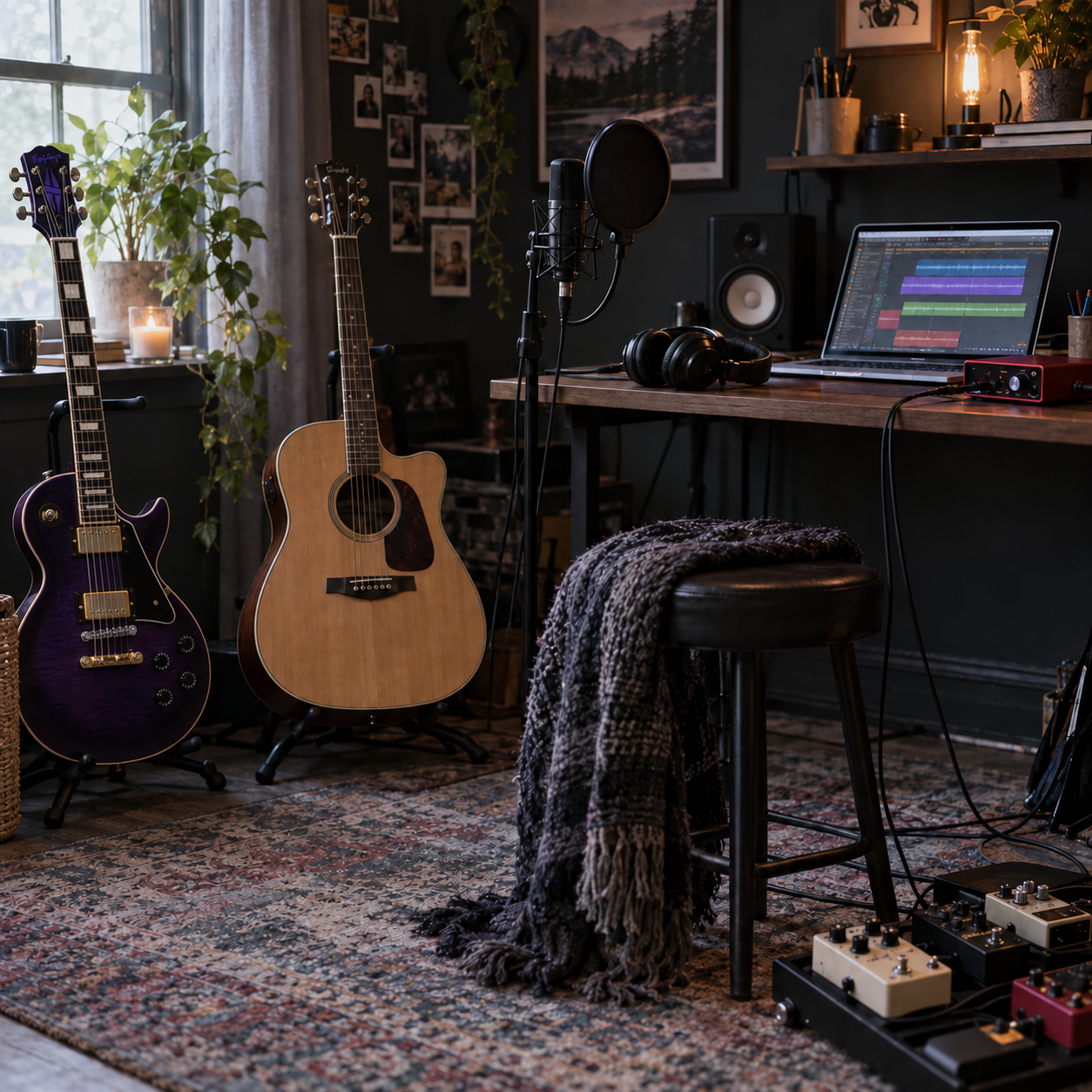
Looking for the best home studio setup for singer-songwriters who record vocals, acoustic guitar, electric guitar, and self-produced songs? These are the music production tools I use or have used, along with a few well-known home-recording options worth comparing if you are building your own creative space.
Disclosure: This post contains paid Amazon affiliate links. As an Amazon Associate I earn from qualifying purchases. If you buy through one of these links, I may earn a commission at no additional cost to you. I clearly separate the gear I personally use from additional products I researched but do not claim to own.
Amazon availability, prices, and ratings change. Check the live product page, recent customer reviews, seller, and specifications before buying.
My Home Studio Setup as an Independent Singer-Songwriter
My approach to music production is centered on the song. I want tools that help me capture an idea, build an arrangement, and move from inspiration to a finished recording without making the process unnecessarily complicated. A home studio does not need to be enormous or filled with the most expensive equipment. It needs to support the way you actually write and record.
Because I work with vocals, acoustic guitar, electric guitar, and different production textures, my setup combines software, instruments, pedals, and practical recording gear. Some pieces shape the sound directly. Others simply make the workflow smoother and more dependable. Together, they form a flexible home recording studio for a singer-songwriter.
FL Studio: Music Production Software I Have Used
FL Studio is one of the music production tools I have used. It gives artists one place to arrange a song, program drums, layer instruments, edit audio, add effects, and mix ideas into a complete track. Its visual workflow can be especially helpful when you like to build a song section by section and hear the arrangement take shape as you work.
For singer-songwriters who want to record live vocals or guitar into FL Studio, compare the current editions before buying; audio recording is available in Producer Edition and above. One of the platform's best-known advantages is Lifetime Free Updates, which can add long-term value for an independent artist.
Compare FL Studio Producer Edition options on Amazon
RØDE NT1 Signature Series: The Studio Microphone I Use
The studio microphone I use is the RØDE NT1 Signature Series. It is an XLR large-diaphragm condenser microphone that works well for the two sounds at the center of my setup: vocals and acoustic guitar. A sensitive condenser mic can preserve quiet details, natural dynamics, and the texture of a performance, which matters when I want a recording to feel personal rather than overly processed.
The NT1 Signature Series has a cardioid pickup pattern, very low self-noise, and the ability to handle loud sound sources as well as intimate vocals. The package also includes a shock mount, pop filter, and XLR cable. Because it is an XLR condenser microphone, it needs an audio interface that can supply 48V phantom power. That is where my Focusrite Scarlett 2i2 fits into the recording chain.
See the RØDE NT1 Signature Series on Amazon
Stedman Proscreen PS101: The Pop Filter I Use
I use the Stedman Proscreen PS101 in front of my RØDE NT1 Signature Series when recording vocals. A pop filter helps control the strong bursts of air created by sounds such as “P” and “B” before they hit the microphone capsule. That can prevent distracting pops from becoming part of an otherwise good vocal take.
Instead of a traditional fabric screen, the PS101 uses a 4.6-inch metal screen designed to redirect airflow downward while allowing the vocal sound to pass through. Its adjustable 13-inch gooseneck and clamp attach to a microphone stand, making it easy to position between the singer and microphone. It is a simple part of my setup, but it helps me capture cleaner vocal recordings before I begin editing or mixing.
See the Stedman Proscreen PS101 on Amazon
Focusrite Scarlett 2i2 4th Gen USB Audio Interface: What I Use to Record
I also use the Focusrite Scarlett 2i2 4th Gen USB Audio Interface. An audio interface converts the signal from a microphone or instrument into audio that a computer can record. The Scarlett 2i2 is the bridge between my RØDE microphone, guitars, and music production software.
Its two inputs give a singer-songwriter useful flexibility: I can connect a vocal microphone and a guitar, use two microphones, or plug an electric guitar directly into an instrument input. The 4th Gen model also includes Auto Gain and Clip Safe features that can help manage recording levels. For a home studio, having two inputs keeps the setup compact without limiting me to only one source.
See the Focusrite Scarlett 2i2 4th Gen on Amazon
The Guitars I Use for Songwriting and Recording
My acoustic and electric guitars serve different parts of the same creative process. The acoustic guitar can carry a song with very little around it, while the electric guitar can introduce color, weight, and contrast.
Martin Special Dreadnought Cutaway 11E Road Series Acoustic-Electric Guitar
The acoustic guitar I use is the Martin Special Dreadnought Cutaway 11E Road Series Acoustic-Electric Guitar. It gives me the familiar body and presence of a dreadnought, while the cutaway makes it easier to reach higher notes. Its built-in electronics also make it practical when I want the option of plugging in instead of relying only on a microphone.
This is the kind of instrument that can begin a song in its simplest form: a voice, a chord progression, and an idea. It is useful for writing, rehearsing, recording, and performing, which makes it an important part of my singer-songwriter setup.
See my exact Martin Special Dreadnought Cutaway 11E at Guitar Center (non-affiliate link)
Compare similar Martin Road Series acoustic-electric guitars on Amazon
My exact Special 11E is a Guitar Center exclusive. The Amazon link above is for similar Martin Road Series models and should not be mistaken for the exact guitar I use.
Epiphone Les Paul Custom Widow Electric Guitar
My purple electric guitar is the Epiphone Les Paul Custom Widow Electric Guitar. Visually, it has a bold identity, and it gives me an electric voice that contrasts with the natural character of my Martin acoustic. I use it when an arrangement calls for a stronger electric presence, sustained notes, or layers that add drama to a track.
A guitar can be practical and inspiring at the same time. The Widow is a memorable instrument, and that visual personality is part of what makes it feel connected to my work as an artist.
See my exact Epiphone Les Paul Custom Widow in Purple Burst at Guitar Center (non-affiliate link)
Compare similar Epiphone Les Paul Custom guitars on Amazon
The Les Paul Custom Widow is a Guitar Center exclusive. The Amazon link above is for similar Epiphone Les Paul Custom models, not the exact Widow guitar I use.
The Electric Guitar Pedals and Power Supply I Use
Pedals let me shape the character of an electric guitar before it becomes part of the full production. They are not required to write a good song, but they can help turn a clean guitar part into something more urgent, spacious, or atmospheric.
BOSS SD-1 Super OverDrive
The BOSS SD-1 Super OverDrive is a straightforward pedal with Drive, Tone, and Level controls. Its asymmetrical clipping creates a focused, mid-forward overdrive that can add grit without automatically overwhelming the guitar. I like having this kind of option when a clean sound needs more energy or when a part should push forward in the mix.
See the BOSS SD-1 Super OverDrive on Amazon
Keeley Caverns Delay Reverb V2
The full name of this pedal is the Keeley Caverns Delay Reverb V2. It combines two effects that are valuable for creating depth: delay and reverb. The delay side offers up to 650 milliseconds of warm, tape-style echo, while the reverb side includes Spring, Shimmer, and Modulated modes.
For me, this type of pedal is about space. It can make an electric guitar feel intimate and close, wide and dreamy, or more cinematic depending on the song. Because delay and reverb are housed together, it can also reduce the number of separate pedals needed for atmospheric sounds.
See the Keeley Caverns Delay Reverb V2 on Amazon
Donner DP-3 Guitar Pedal Power Supply
The Donner DP-3 is the power center for a pedalboard rather than an effect that changes the sound. Its multiple isolated DC outputs are designed to power several pedals, including common 9V pedals as well as compatible 12V and 18V equipment.
A dedicated power supply helps keep a multi-pedal setup organized and reduces the need for a collection of separate adapters. Always confirm the voltage, polarity, and current requirement of every pedal before connecting it; matching those specifications matters more than convenience.
See the Donner DP-3 pedal power supply on Amazon
Additional Home Studio Gear Worth Comparing
The products below are additional options I researched, not gear I am claiming to personally own or use. They are established choices that appear often in home-studio conversations and have received positive buyer feedback. Since Amazon ratings can change at any time, use the links to check the current rating, recent written reviews, and product details for yourself.
Alternative Home Studio Microphones to Compare
Although the RØDE NT1 Signature Series is the microphone I personally use, these are two other established options readers may want to compare based on their room, budget, and recording needs.
Audio-Technica AT2020: A Condenser Microphone for Detail
The Audio-Technica AT2020 is a popular XLR condenser microphone for project and home studios. A condenser can capture vocal detail and the natural texture of an acoustic guitar, especially in a reasonably quiet, controlled room. It requires an audio interface with XLR input and phantom power, so include those needs in your budget.
Check the current AT2020 details and reviews on Amazon
Shure SM58: A Dynamic Microphone for Less-Controlled Rooms
The Shure SM58 is a rugged XLR dynamic vocal microphone. Compared with a sensitive condenser, a dynamic mic can be easier to manage in an untreated bedroom or a space with more background noise. It is also a practical choice if you want one microphone that can move between home recording, rehearsal, and live vocals.
Check the current Shure SM58 details and reviews on Amazon
Which microphone is better? If your room is quiet and you want more detail, start by comparing the AT2020. If your room is untreated or you need a durable all-purpose vocal mic, compare the SM58. The best home studio microphone is the one that fits your voice, room, interface, and recording habits.
Best Guitar Amps for a Home Studio: Three Types to Compare
Fender Mustang LT25: Compact Modeling Amp
The Fender Mustang LT25 is a compact 25-watt modeling amp with built-in presets, effects, USB connectivity, and a headphone output. It is worth comparing if you want a smaller amp with multiple tones for practice and home recording without immediately building a large pedal collection.
Check the Fender Mustang LT25 on Amazon
BOSS Katana-50 Gen 3: More Power and Room to Grow
The BOSS Katana-50 Gen 3 is a 50-watt, 1x12-inch modeling combo with multiple amp characters, onboard BOSS effects, and USB-C connectivity. It may suit a guitarist who wants more volume and flexibility for rehearsal, recording, and future performances while keeping effects in one main system.
Check the BOSS Katana-50 Gen 3 on Amazon (paid link)
Fender Acoustasonic 40: An Acoustic-Focused Option
For an acoustic-electric setup, the Fender Acoustasonic 40 is another option to compare. It is a 40-watt acoustic combo with two channels and built-in reverb, designed for acoustic instruments and compatible vocal use. Check the current input specifications and your microphone connection before deciding whether it fits your setup.
Check the Fender Acoustasonic 40 on Amazon
Headphones and Monitors for Making Better Mix Decisions
Audio-Technica ATH-M50x Headphones
Closed-back headphones are useful for recording vocals because they help keep the backing track out of the microphone. The Audio-Technica ATH-M50x is a widely used closed-back studio headphone worth comparing for tracking, editing, and late-night production. As with any headphones, learn how your favorite commercial songs sound on them before trusting a mix decision.
Check the Audio-Technica ATH-M50x on Amazon
PreSonus Eris 3.5 Studio Monitors
The PreSonus Eris 3.5 pair is a compact monitor option for a desk or bedroom studio. Small monitors will not reproduce the deepest bass like a larger system, but they can give you a useful second perspective after headphones. Comparing a mix on monitors, headphones, a phone, and ordinary speakers is often more revealing than relying on only one playback system.
Check the PreSonus Eris 3.5 monitors on Amazon
What Should a Beginner Buy First for a Home Studio?
If you are starting from zero, you do not need to buy everything at once. A sensible order for a beginner singer-songwriter is:
- A computer and DAW: Choose software that makes you want to create. If you plan to record audio in FL Studio, compare editions carefully.
- An audio interface: This connects an XLR microphone or electric instrument to your computer.
- One microphone that suits your room: A condenser can reveal detail; a dynamic mic can be more forgiving in a noisy or untreated room.
- Closed-back headphones: These let you record and edit without needing speakers immediately.
- Essential accessories: Budget for the correct cables, a stable mic stand, a pop filter, and safe power supplies.
- Monitors, amps, and pedals later: Add them when you know what your current setup cannot do.
Buying in stages gives you time to learn each piece of equipment. It also makes it easier to tell whether a new purchase actually improves your recordings.
How These Music Production Tools Shape My Sound
Each part of my setup has a different job. The Stedman Proscreen PS101 helps control vocal plosives before they reach the RØDE NT1 Signature Series, which captures my vocals and acoustic performances. The Focusrite Scarlett 2i2 then brings those signals into my computer. The Martin acoustic supports the direct, singer-songwriter side of a song. The purple Epiphone Les Paul Custom Widow gives me a distinct electric voice. The BOSS SD-1 can add drive and urgency, while the Keeley Caverns can create depth and atmosphere. The Donner DP-3 helps keep the pedal setup powered, and FL Studio gives me a space to arrange and develop ideas.
The goal is not to use every tool on every track. It is to have the right choices available when a song asks for them. Sometimes the best production is a voice and an acoustic guitar. At other times, an electric layer or a wash of delay and reverb is what gives the track its identity.
Home Studio Setup FAQ
Is FL Studio good for singer-songwriters?
Yes. FL Studio can support songwriting, beat creation, arranging, recording, editing, and mixing. If live vocal or guitar recording is essential to you, choose an edition that includes audio recording.
What is the best microphone for a singer-songwriter home studio?
The microphone I use is the RØDE NT1 Signature Series, an XLR condenser mic that captures detailed vocals and acoustic guitar. There is still no single best microphone for every singer. Another condenser such as the AT2020 may suit a quiet room where detail matters, while a dynamic mic such as the SM58 may be easier in a room with more reflections or background noise.
Do I need a guitar amp to record electric guitar at home?
No. You can connect a guitar to a suitable audio interface and use amp-simulation software. A physical amp is another creative option if you prefer its feel, built-in effects, speaker sound, or use for rehearsal and performance.
Are guitar pedals necessary for home recording?
No. Pedals are tone choices, not requirements. Start with the instrument, interface or amp, and a clean recording workflow. Add pedals when you know you want a specific sound or a hands-on way to perform effects.
What equipment is essential for a basic home recording studio?
Most singer-songwriters can begin with a computer, DAW, audio interface, suitable microphone, closed-back headphones, the correct cables, and an instrument. Acoustic treatment, monitors, amps, pedals, and additional microphones can come later.
Do I need a pop filter to record vocals at home?
A pop filter is not required for a microphone to work, but it can make vocal recording easier by reducing bursts of air from plosive consonants before they reach the microphone. I use the Stedman Proscreen PS101 with my RØDE NT1 Signature Series as part of my vocal-recording setup.
Final Thoughts on Building Your Own Home Studio
The best home studio setup for singer-songwriters is not the setup with the longest shopping list. It is the one that lets you write regularly, record clearly, and finish songs. My combination of FL Studio, the RØDE NT1 Signature Series, the Stedman Proscreen PS101, the Focusrite Scarlett 2i2 4th Gen, the Martin Special Dreadnought Cutaway 11E, the Epiphone Les Paul Custom Widow, the BOSS SD-1, the Keeley Caverns V2, and the Donner DP-3 gives me multiple ways to move from an idea to a fuller production.
If you are building your own studio, start with the weakest link in your current workflow. Choose one upgrade, learn it well, and let the music—not the gear list—guide the next decision.
Want to hear how these creative choices connect to my releases? Listen to my music, and read more about my late-night songwriting process and why I release music so often.