
Affiliate disclosure: This post contains affiliate links. If you buy through one, I may earn a commission at no extra cost to you. As an Amazon Associate I earn from qualifying purchases.
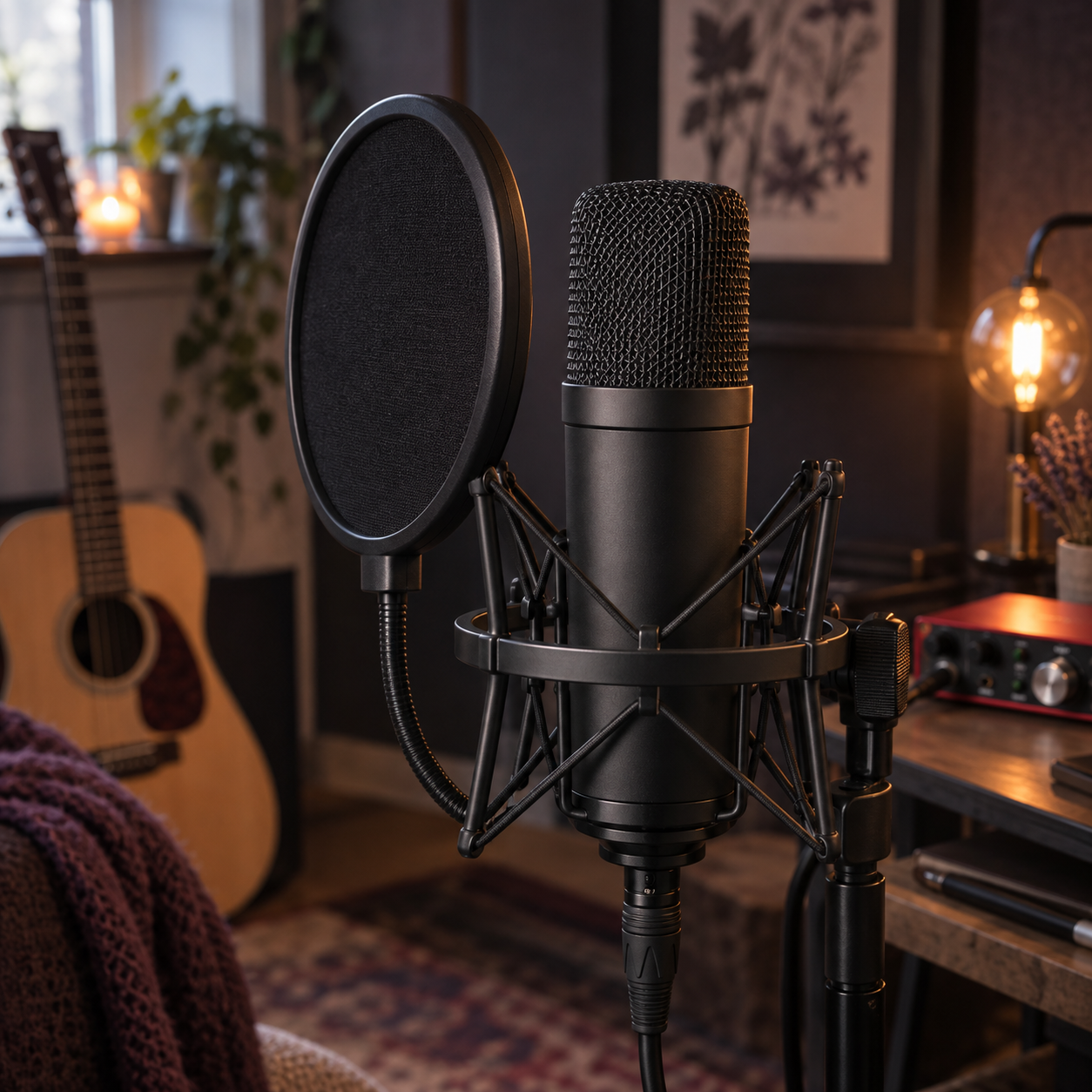
Is the RØDE NT1 Signature Series good for female vocals? For the kind of recording I do, it is a strong fit. I use it in my home studio for both vocals and acoustic guitar, paired with a Focusrite Scarlett 2i2 audio interface and a Stedman Proscreen pop filter.
My music often depends on quiet details, natural dynamics, and the texture of a performance. I do not want every vocal to feel flattened or overly processed. The NT1 fits into a simple XLR recording chain that lets me focus on the song while still capturing a clean signal.
That does not mean it is automatically the best microphone for every woman’s voice. “Female vocals” covers an enormous range of tones, registers, styles, and delivery. Your room, microphone technique, interface, and voice all affect the result. This review explains how I use the NT1, what its specifications mean in a real home studio, and the situations in which another microphone might make more sense.
Quick verdict: The RØDE NT1 Signature Series is worth considering if you are a singer-songwriter who wants one quiet, versatile XLR condenser microphone for detailed vocals and acoustic instruments. You will need an audio interface with 48V phantom power, and a reflective or noisy room may require extra care.
Check the RØDE NT1 Signature Series on Amazon (paid link)
What I use the RØDE NT1 Signature Series for
I use the NT1 for two central parts of my home-studio workflow:
- recording vocals;
- recording acoustic guitar.
That versatility matters to me. Instead of keeping a different microphone ready for every source, I can use one familiar mic for the core of a singer-songwriter arrangement. I already know how it fits into my setup, and I can spend more time thinking about phrasing, emotion, and the performance itself.
This is my actual recording chain:
Voice or acoustic guitar → RØDE NT1 Signature Series → Focusrite Scarlett 2i2 → DAW
For vocals, I also place a Stedman Proscreen PS101 between me and the microphone to control plosives such as hard “p” and “b” sounds. A pop filter does not replace good microphone technique, but it can help produce cleaner takes and reduce editing later.
If you want to see the rest of the equipment around this chain, read my complete home studio setup for singer-songwriters.
Is the RØDE NT1 good for female vocals?
Yes, it can be—but the useful answer is more specific than that.
The NT1 Signature Series is a large-diaphragm cardioid condenser microphone. Condenser microphones are often chosen for studio vocals because they can capture detail and small changes in a performance. The NT1’s published self-noise is only 4dBA, which is especially relevant when recording quieter passages: the microphone itself contributes very little noise to the signal.
That combination suits what I care about in a vocal recording. A song may move from a close, quiet line into a stronger section, and I want the performance to retain those contrasts. The microphone also has a published maximum sound pressure level of 142dB SPL, so it has plenty of capacity for more powerful moments when the gain is set correctly.
Still, there is no microphone that is universally “best for female vocals.” A bright voice, a dark voice, a breathy delivery, and a powerful belt will not interact with one microphone in exactly the same way. Before deciding, listen to your own recordings and ask:
- Does the microphone preserve the parts of my voice I like?
- Does it exaggerate sibilance or room reflections in my space?
- Can I get a clean level without clipping?
- Does the result sit naturally in the kind of music I make?
The label matters less than the match between the microphone, the individual voice, and the room.
The specifications that matter in a home studio
Here are the main published specifications I would pay attention to—not because numbers tell you whether you will love a microphone, but because they clarify what the NT1 is designed to do.
| Feature | RØDE NT1 Signature Series | Why it matters |
|---|---|---|
| Microphone type | Large-diaphragm condenser | Designed to capture detail in studio sources such as voice and acoustic instruments |
| Polar pattern | Cardioid | Focuses mainly on sound arriving from the front while reducing sound from behind |
| Connection | XLR | Requires an audio interface or microphone preamp; it does not plug directly into a computer by USB |
| Frequency range | 20Hz–20kHz | Covers the standard audible frequency range |
| Self-noise | 4dBA | Helps keep the microphone’s own noise low during quiet recordings |
| Maximum SPL | 142dB SPL | Provides headroom for loud sources when the rest of the setup is adjusted properly |
| Required power | 48V phantom power | Must be enabled on a compatible interface or preamp |
These figures come from RØDE’s official NT1 Signature Series specifications and RØDE’s user guide.
One important distinction: low self-noise does not mean the microphone will remove noise from your room. A sensitive condenser mic may also capture computer fans, traffic, air conditioning, reflections, and movement. The 4dBA figure refers to noise created by the microphone itself, not everything around it.
My RØDE NT1 and Scarlett 2i2 setup
The NT1 Signature Series is an XLR microphone, so it needs an audio interface. I use the Focusrite Scarlett 2i2 4th Gen. It supplies the required 48V phantom power and converts the microphone signal into audio my computer and recording software can use.
The 2i2 has two inputs, which gives a singer-songwriter useful flexibility. Depending on the session, those inputs can support a vocal mic plus another source, two microphones, or a direct instrument connection. Focusrite also includes Auto Gain and Clip Safe on this model. Those can be useful safeguards while setting levels, although careful listening and a short test recording are still important.
See the Focusrite Scarlett 2i2 4th Gen on Amazon (paid link)
Focusrite lists a 120dB dynamic range, 69dB of gain range, two microphone preamps, and 24-bit/192kHz capability for the current Scarlett 2i2. You can read the full details on the official Focusrite Scarlett 2i2 product page.
A simple setup sequence
If you are connecting an NT1 to an interface for the first time, this is a practical starting sequence:
- Mount the microphone securely in its shock mount.
- Turn the monitor or headphone level down before connecting equipment.
- Connect the NT1 to the interface with an XLR cable.
- Connect the interface to the computer and select it in your recording software.
- Enable 48V phantom power on the interface.
- Set your microphone position and record a short performance at the loudest level you expect to sing.
- Adjust the input gain so the signal stays healthy without clipping.
For vocals, start with the front of the microphone facing you and leave enough distance for a pop filter. Around six to eight inches from the mic can be a useful starting point, but it is not a rule. Moving closer usually changes both the level and the low-frequency response, while moving farther away increases the amount of room sound in the recording. Test, listen, and adjust for your voice.
The NT1 package includes a shock mount, pop filter, and XLR cable. I use a separate Stedman Proscreen PS101 in my own vocal setup.
See the Stedman Proscreen PS101 on Amazon (paid link)
Using the RØDE NT1 for acoustic guitar
The same qualities that make a quiet condenser useful for vocals also make the NT1 a practical option for acoustic guitar. It can capture pick detail, string movement, and the changes in intensity that give a performance its character.
Placement makes a major difference. Pointing a microphone directly at the sound hole can create a boomy result. A common starting point is to aim toward the area around the 12th fret from several inches away, then move the microphone while listening through headphones. Shifting it toward the sound hole generally adds body; shifting it toward the neck generally reduces boom and emphasizes more string detail.
That is a starting method, not a fixed formula. The guitar, room, playing style, and arrangement should guide the final position. Always record a short test and listen in the context of the song rather than judging the soloed track alone.
What I like about this setup
One microphone covers my two main sources
I can use the NT1 for vocals and acoustic guitar, which keeps my core workflow straightforward. That is valuable when I want to capture an idea without turning the setup itself into a project.
Its low self-noise supports quiet performances
With a published self-noise of 4dBA, the NT1 itself adds very little noise. That is useful when a vocal or guitar part includes soft details that need more gain.
It leaves room for dynamic performances
The 142dB maximum SPL does not mean every recording will automatically be clean—gain staging still matters—but it means the microphone can handle substantial sound pressure. For music that moves between restrained and stronger passages, that technical headroom is reassuring.
The package includes the essential accessories
The included shock mount, pop filter, and XLR cable reduce the number of separate items a first-time buyer needs. You still need an interface, headphones or monitors, recording software, and an appropriate stand.
What to consider before buying
It is not a USB microphone
The NT1 Signature Series uses XLR. If you want a microphone that connects directly to a laptop with no interface, this particular model is not that. The interface adds cost and another step, but it also gives you more control and makes it easier to expand an XLR-based studio later.
A condenser microphone can reveal your room
Detail is helpful until the detail is your computer fan, a bare-wall reflection, or traffic outside. Cardioid pickup reduces sound from the rear, but it does not soundproof a space. In a lively room, soft furnishings, thoughtful microphone placement, and recording at a quieter time can matter as much as the microphone choice.
Every voice still needs a listening test
Specifications can narrow a shortlist, but they cannot tell you exactly how a microphone will sound on your voice. If possible, buy from a seller with a clear return policy or try the microphone before the return window closes. Record the same passage at several distances, with minimal processing, and compare the results on both headphones and speakers.
Who I think the NT1 Signature Series suits
The NT1 is a sensible option to consider if you:
- sing and record acoustic instruments at home;
- want one versatile studio microphone for several sources;
- already have, or plan to buy, an interface with 48V phantom power;
- value quiet recordings and the detail of a natural performance;
- are willing to experiment with placement and improve the sound of your recording space.
You may want to consider another option first if you:
- need a direct USB connection with no interface;
- record in a consistently noisy or highly reflective room;
- mainly need a rugged handheld microphone for live performance;
- want a microphone that deliberately colors the sound rather than a flexible studio starting point.
Frequently asked questions
Does the RØDE NT1 Signature Series need phantom power?
Yes. It is a condenser microphone and requires 48V phantom power from an audio interface or microphone preamp. The Focusrite Scarlett 2i2 I use provides it.
Can I plug the NT1 Signature Series directly into a computer?
No. The Signature Series model uses an XLR connection, so you need an audio interface between the microphone and computer.
Is the RØDE NT1 good for soft or breathy vocals?
Its very low published self-noise makes it technically well suited to capturing quiet detail. The final sound will still depend on the voice, room, microphone distance, gain setting, and processing.
Do I need a pop filter with the RØDE NT1?
A pop filter is strongly recommended for close vocal recording because it helps control bursts of air from plosive consonants. The NT1 Signature Series package includes one. I use a Stedman Proscreen PS101 in my setup.
Can the RØDE NT1 record acoustic guitar?
Yes. I use mine for acoustic guitar as well as vocals. Placement is important, so begin with a short test near the 12th-fret area and adjust by listening.
Final verdict
The RØDE NT1 Signature Series earns its place in my home-studio workflow because it covers the two sources I record most: vocals and acoustic guitar. Its low self-noise, high maximum SPL, and traditional XLR connection make it a capable foundation for a singer-songwriter setup.
It is not a magic solution for every female voice, and it will not hide a noisy room. What it offers is a quiet, versatile starting point that can preserve the dynamics and detail I care about when I record. Paired with the Scarlett 2i2, a pop filter, careful gain settings, and thoughtful placement, it gives me a simple recording chain that stays out of the way of the performance.
Check the RØDE NT1 Signature Series on Amazon (paid link)
You can hear more of my work on my official music page, or explore the rest of my singer-songwriter home-studio gear.