
Find the best vocal preamp for singers with four home-studio picks, honest trade-offs, Amazon buying links, and Scarlett 2i2 setup tips.
A great vocal take can move from a quiet verse to a full chorus in seconds. If you record yourself, you need a setup that captures both without turning every session into a technical project. A dedicated preamp can add gain, a particular tone, or useful recording controls—but the right choice depends on what your current setup is missing.
Affiliate disclosure: As an Amazon Associate I earn from qualifying purchases. This post contains affiliate links. If you buy through them, I may earn a commission at no additional cost to you.
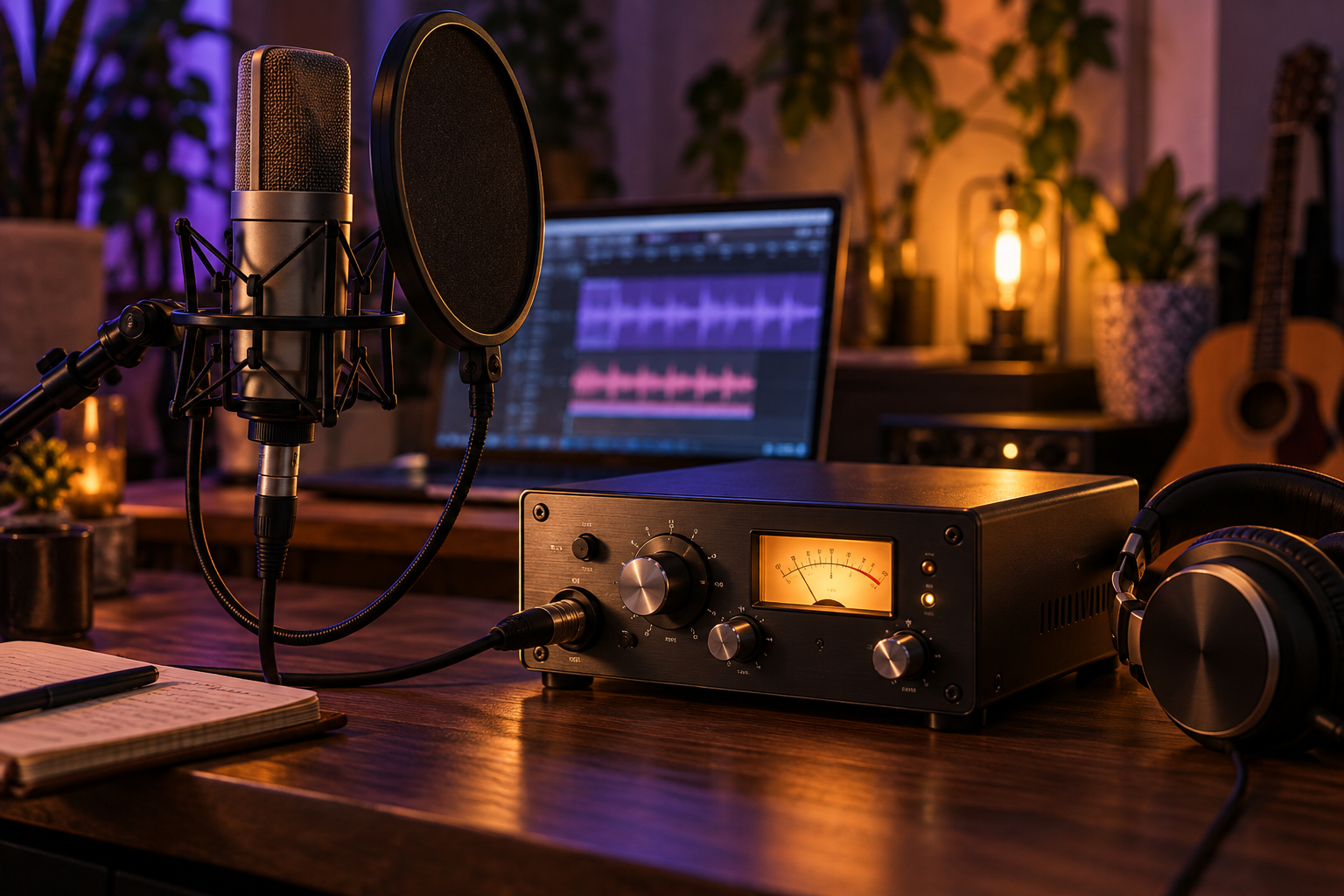
Original AI-generated studio illustration. The equipment shown is illustrative.
The quick answer: which vocal preamp should you choose?
For a versatile dedicated vocal preamp, my shortlist starts with the Focusrite ISA One. Its transformer-based mic stage, adjustable input impedance, and monitoring options make it a useful choice for singers building a more flexible recording setup.
For a deliberate character option, look at the Warm Audio WA12 MKII. For processing vocals before recording, consider the dbx 286s. For a smaller entry into external hardware, the ART Tube MP Studio V3 is worth comparing.
Already getting clean recordings through an audio interface? Keep using it until you can name the specific improvement you want. A separate preamp is an optional upgrade, and a reflective room or inconsistent mic distance can matter more than another box on your desk.
Best vocal preamp for singers: comparison at a glance
| Preamp | Best fit | Main trade-off |
|---|---|---|
| Focusrite ISA One | Versatile standalone vocal recording | Larger desktop unit; no built-in compressor |
| Warm Audio WA12 MKII | Exploring analog character and saturation | Driven tone becomes part of the recorded take |
| dbx 286s | Hardware compression and de-essing | More controls; processing needs care |
| ART Tube MP Studio V3 | An entry-level tube and voicing option | Presets require listening and level checks |
Check the current Amazon price, seller, condition, included power supply, and exact model before ordering. Prices and availability change. These recommendations are for studio recording; none of these standard analog units replaces the USB audio interface needed to record into a computer.
How I chose these vocal preamps
This is a research-based buying guide built around manufacturer specifications, connection requirements, and four different recording needs. I am not claiming hands-on testing of these four units. My own home-studio setup includes a RØDE NT1 and Scarlett 2i2 4th Gen, so practical compatibility matters here.
The recommendations below are buying judgments based on those features. Your microphone, voice, room, and gain settings will influence the result.
1. Focusrite ISA One: best for a versatile dedicated vocal setup
The ISA One is a strong starting point if you want a dedicated mic stage with room to grow. Focusrite specifies a Lundahl input transformer, four input-impedance choices, a separate instrument DI, a headphone output, and an insert connection for additional processing.
Those features suit a singer-songwriter who records vocals and instruments and wants more control over the recording chain. Adjustable impedance offers another way to explore the interaction between the preamp and microphone; it is worth auditioning rather than assuming one setting will suit every voice.
Buy it if: You want a flexible standalone vocal preamp and will use its monitoring or routing features.
Think twice if: You mainly need compression and de-essing in one box, or you are still solving basic room and microphone problems. The standard analog ISA One does not include a compressor or a USB recording connection. Its digital conversion card is an optional purchase.
Buy the Focusrite ISA One on Amazon
2. Warm Audio WA12 MKII: best for exploring vocal character
The WA12 MKII is my character-focused pick. Warm Audio describes a fully discrete, transformer-balanced design with up to 71 dB of gain, a pad, phantom power, and separate gain and output controls.
The output control is especially useful: you can drive the preamp harder while reducing the level sent onward to your interface. That gives you a way to explore saturation without simply making the computer input louder. Start gently, especially on a voice with bright consonants or a strong belt.
Buy it if: You want to experiment with the tone of a vocal before it reaches your recording software. It is a sensible audition candidate for rock, country, and rap vocals when a more assertive character is part of the creative goal.
Think twice if: You want maximum flexibility to change the tone after recording. Saturation captured on the way in cannot simply be turned off later. This is a preamp, so you still need separate tools for compression and de-essing.
Buy the Warm Audio WA12 MKII on Amazon
3. dbx 286s: best for processing vocals before recording
The dbx 286s combines a microphone preamp with a compressor, de-esser, enhancer, and expander/gate. It also provides phantom power and an 80 Hz high-pass filter. That makes it a different purchase from a simple gain-and-tone preamp.
For a singer who also livestreams or wants a repeatable hardware vocal chain, having those controls together can be convenient. For song recording, begin with the processing bypassed, establish a clean level, and add only what helps the performance.
Buy it if: You specifically want hardware dynamics and sibilance control before the signal enters your interface.
Think twice if: You prefer editing everything in your DAW. Heavy compression or de-essing becomes part of the recording. An aggressive gate can also interrupt quiet phrases, breaths, and sustained endings—the details that often give a vocal its emotion.
Use the gate cautiously and check an entire verse and chorus before committing to the settings.
4. ART Tube MP Studio V3: best for an entry into external hardware
The ART Tube MP Studio V3 is a compact option for exploring tube-based voicing. ART lists a 12AX7A tube, 16 preset voicings, phantom power, an analog VU meter, and Output Protection Limiting. Its presets include neutral, warm, and limiting options.
That makes it approachable for experimenting: record a short phrase with a neutral setting, then compare another voicing at a similar playback level. Treat the preset name as a starting suggestion. A setting labeled for vocals still needs to suit your actual microphone and performance.
Buy it if: You want a smaller, entry-level hardware option and enjoy trying different voicings.
Think twice if: You expect an automatic improvement over the preamps already in a modern interface. Compare recordings before deciding whether its character is useful to you.
Connection detail: ART specifies a balanced XLR output and an unbalanced quarter-inch TS output. For a balanced connection to a Scarlett line input, use the XLR output with an XLR-female-to-TRS cable.
Buy the ART Tube MP Studio V3 on Amazon
Do singers need an external vocal preamp?
You need a microphone preamp somewhere in the recording chain, but an audio interface usually already provides one. A separate unit makes sense when you have a clear goal: additional usable gain, a particular analog character, or hardware controls that your interface does not offer.
Before shopping, record a dry verse and chorus through your current setup. Listen for the actual problem:
- Room echo: Improve the recording position and acoustic treatment first.
- Distortion on loud notes: Reduce gain and test the loudest phrase before recording.
- Big changes in loudness: Work on mic distance and use careful compression or volume automation.
- A clean recording that needs more character: Audition a dedicated preamp or try tonal processing in your DAW.
A preamp cannot make every vocal sound finished. If your voice feels buried in the song, also check the arrangement, competing instruments, and vocal level. More input gain is not the same as a better-balanced mix.
How to connect a vocal preamp to a Scarlett 2i2
The basic chain is: microphone → external preamp → interface line input → recording software.
For the Scarlett 2i2 4th Gen, Focusrite directs external preamps to the front quarter-inch jack inputs, with Inst turned off. Even if the preamp has an XLR output, connect it to that jack using the appropriate XLR-female-to-TRS cable. The rear XLR sockets are microphone inputs.
- Turn monitoring down and connect your microphone to the external preamp with an XLR cable.
- Connect the preamp's line output to one interface line input. Use a balanced TRS-to-TRS or XLR-female-to-TRS cable when the equipment supports it.
- Enable phantom power on the external preamp only if your microphone requires it, following the mic's instructions.
- Start with low gain and output settings. Sing the loudest part, then adjust the external preamp and interface while watching both sets of meters.
- Record to a mono track and leave headroom. A useful starting target is around −12 dBFS for the loudest peaks in your DAW; avoid clipping anywhere in the chain.
A detail worth knowing: The 2i2's line inputs still use a variable gain stage. Selecting line operation does not completely bypass all preamp circuitry. Start with the interface gain low and raise it only as needed.
Keep the interface's Air mode off for your first comparison so you can hear the external preamp more clearly. Other interface models handle line inputs differently, so check your exact model's manual.
A simple vocal preamp comparison you can do at home
Keep the same microphone, distance, room position, and recording settings. Capture the same short passage through your interface alone and through the external preamp. Include a quiet line, a loud line, an “S” sound, and a held ending.
Match the playback volume before judging. A louder recording can seem more impressive even when the difference is mostly level. Listen both solo and inside your song: does the take keep its detail, feel right emotionally, and give you a sound you would choose again?
For checking those decisions on speakers, see my guide to the best studio monitors for vocalists. For the microphone side of the chain, read my RØDE NT1 Signature Series review.
Frequently asked questions
What is the best vocal preamp for singers recording at home?
For a flexible dedicated setup, the ISA One leads this shortlist. Choose the WA12 MKII for exploring character, the dbx 286s for hardware processing, or the ART Studio V3 for an entry-level voicing option. The best purchase is the one that solves a need you can identify.
Will a vocal preamp make my voice louder?
It raises the microphone signal to a usable recording level. The final vocal loudness in your song depends on your mix, including the fader, automation, and dynamics processing. Do not overdrive the recording input to make the finished track louder.
Is a tube preamp better for female vocals or high voices?
There is no universal winner based on gender or vocal range. Compare how the actual mic and settings handle your vowels, consonants, and loudest notes. Choose the sound that serves the song rather than assuming “tube” guarantees warmth.
Can I use one of these preamps with a USB microphone?
A USB-only microphone usually sends audio directly to the computer and cannot feed a conventional analog mic preamp. A microphone with separate XLR and USB options may work through its XLR output; check the microphone's instructions.
Is an inline mic booster the same as a standalone preamp?
An inline booster typically adds gain before an existing mic preamp. Check its power and microphone compatibility carefully, especially with a condenser. It does not necessarily provide the line output, tone controls, or processing offered by a standalone unit.
Which one would I put on the shopping shortlist?
If you are ready for an external preamp and want a flexible vocal setup, start by comparing the ISA One. If your main goal is adding character before recording, audition the WA12 MKII. Those are two different reasons to upgrade.
Choose the dbx 286s when its hardware processing is the feature you need. Choose the ART Studio V3 for a smaller entry into voicing experiments. If your current interface already gives you a clean take you love, put the money toward the next part of your studio that actually needs attention.
Check WA12 MKII price on Amazon
Want to hear the music behind this home-studio journey? Listen to N!CØLE, and explore the songs and stories throughout the blog.
Specifications and setup references
Features and connections were checked against the manufacturers' published information in October 2026: Focusrite ISA One, Warm Audio WA12 MKII, dbx 286s, and ART Tube MP Studio V3. For interface routing, see Focusrite's line-level connection guide and line-input gain-stage explanation.